Studio
Two people, one shop
Techplay is Dan Fury and Sunny, in Phuket. Here is what that actually means for a game with 2,080 physics objects in it.
Techplay is two people. Dan Fury and Sunny, in Phuket, Thailand. There is no third person, and there has not been at any point.
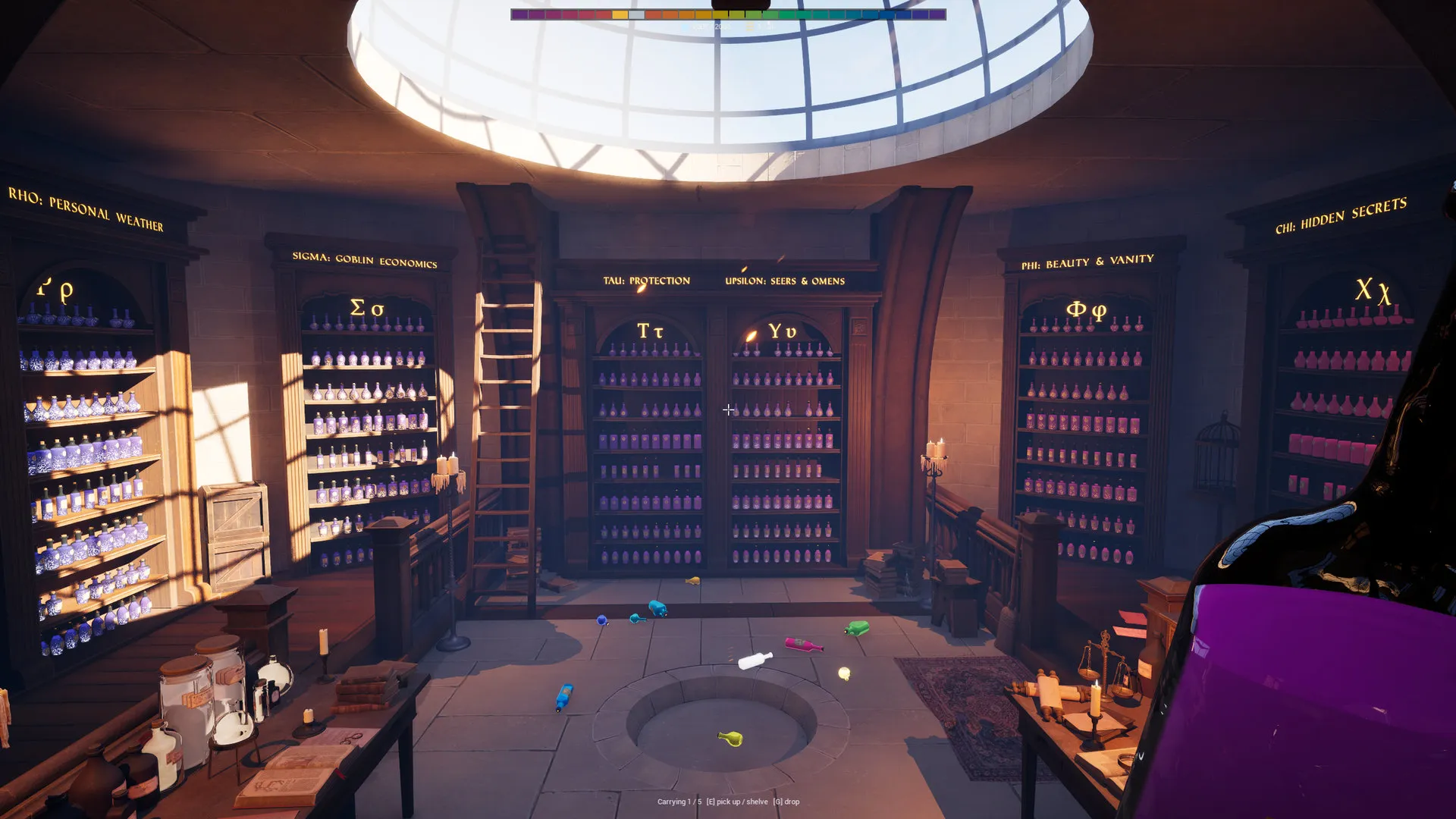
We mention this not as a hard-luck story — it is a very pleasant way to make a game — but because people reasonably assume a room with 2,080 individually simulated objects in it came out of a larger building.
What two people actually buys you
Decisions are fast. The timer came out of the game in an afternoon, in a conversation, with nobody to convince. The Purist mode exists because one of us wanted it and the other could not think of a reason to say no. A studio with a process would have handled both better and slower.
Scope is honest. There is one room. There is no story mode, no progression tree, no shop upgrades, no second location that unlocks at 40%. Not because we cut them — because we never had the people to build them, so we never designed them, so the game is only the thing it is good at.
Everything is in one place. The person who wrote Ambrosia of the Poltergeist Paying Monthly Rent also placed the shelf it belongs on. That is not a virtue in itself, but it does mean the jokes and the room agree with each other.
The technical part
The shop runs on Unreal Engine 5.8 — Lumen, Nanite and Substrate, plus optional hardware ray tracing and ray-traced shadows if your card wants to. Upscaling is NVIDIA DLSS 4 or AMD FSR 4.1.1, offered to match the GPU you actually have.
The heap is real physics. Every bottle is an object: kick one and it goes, pull one out of the middle of a stack and the bottles above it notice, and the liquid sloshes as you carry it. Getting two thousand of those to behave in one room, on a GTX 1660, was most of a year.
17 September
Alchemess launches on 17 September 2026, on Steam and the Epic Games Store the same day, at US$5.99 with a 10% discount in the launch week.
If you are reading this before then, a wishlist genuinely helps — it is the main thing Steam looks at when deciding whether to show a small game to anybody.
And if you are reading it after: the shop is open, the floor is covered, and there is no rush at all.